
Customizing a thank-you card after a funeral involves choosing between several visual and textual elements: photo of the deceased, quote, religious or secular symbol, handwritten line. Each option produces a different effect on the recipient, and certain combinations can weigh down the message instead of making it more touching. The challenge boils down to a balance between simplicity and personalization.
Photo, symbol, and quote on a funeral card: what each element brings
Not all graphic or textual elements play the same role in a death thank-you message. The table below compares their function, level of risk, and relevance according to the medium.
| Element | Main function | Risk if misused | Suitable medium |
|---|---|---|---|
| Photo of the deceased | Anchor the memory in a face | Too intimate a tone for a colleague or distant relation | Printed card, memorial booklet |
| Literary or poetic quote | Express what the family cannot articulate | Too well-known a phrase, perceived as impersonal | Printed card, announcement |
| Religious symbol (cross, star, crescent) | Affirm a spiritual belonging | Clumsiness if the recipient does not share the faith | Printed card, grave marker |
| Secular symbol (tree, dove, flower) | Evoking peace or the cycle of life without confessional connotation | Generic appearance if the symbol has no connection to the deceased | Card, medallion, announcement |
| Added handwritten line | Create a personal connection with the recipient | Overload if added to an already long text | Pre-printed card |
The choice of a death thank-you card relies on the combination of two or three of these elements, rarely more. Stacking photo, quote, symbol, and long text creates an overloaded medium that loses readability.
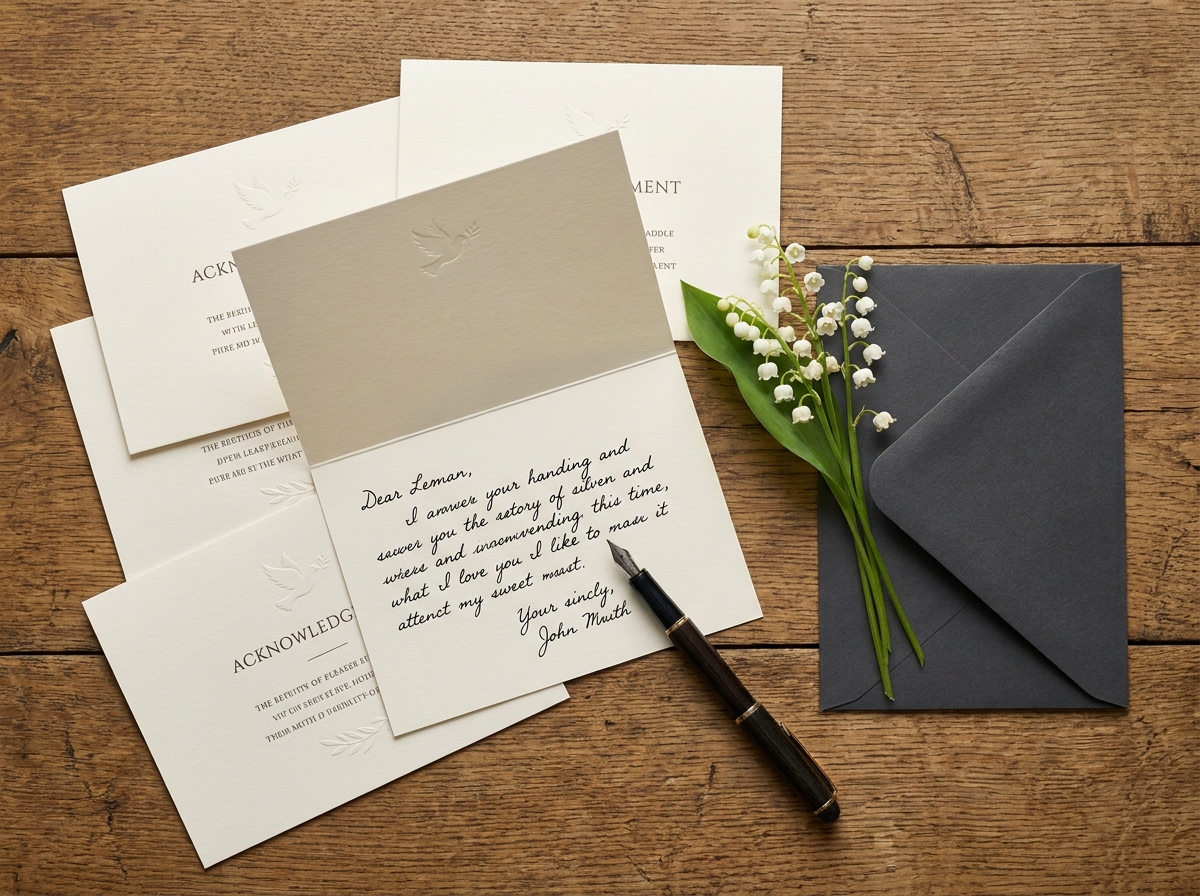
Photo of the deceased on a funeral thank-you: when to keep it, when to forgo it
The photo remains the most personal element a family can include. It transforms a thank-you card into a memory object.
Its use is justified when the circle of recipients personally knew the deceased: close family, long-time friends, neighbors. A simple photo, either a bust or outdoors, works better than an event snapshot (wedding, party) that directs the emotion toward a specific moment rather than the person.
On the other hand, for professional relationships or distant acquaintances, the photo creates a disconnect. The recipient receives a portrait they may not always recognize, which weakens the intention. In this case, a discreet symbol or a simple text suffices.
Distinction between thank-you card and memorial support
A recent trend more clearly separates the thank-you card from the memorial support. Elements like the QR code linking to a tribute page or the photo medallion belong on a memorial booklet or commemorative image, not on the message of gratitude sent to loved ones. The thank-you card remains a letter of gratitude, not a mourning object.
Quotes and short texts: the pitfalls of the cliché
Famous quotes pose a problem of trivialization. When the same line from Victor Hugo or Saint-Exupéry appears on the majority of cards, it loses its ability to move. The recipient recognizes it before even reading it, and the message seems automated.
Three approaches yield a more fitting result:
- Reusing a phrase that the deceased often used, even if trivial. It speaks directly to those who knew them and anchors the memory in reality.
- Choosing a lesser-known excerpt from an author the deceased appreciated. A passage from a novel or private correspondence surprises more than a famous maxim.
- Writing an original sentence from the family, even if short. Two sincere lines leave a stronger impression than a prestigious quote.
The name of the deceased integrated into the text personalizes it more than a universal quote. A phrase like “The family of [first name] thanks you for your presence and support” remains simple, but it names, and that is what matters.
Religious and secular symbols on a death thank-you message
The choice of symbol engages an immediate reading from the recipient. A cross, a Star of David, or a crescent affirms a confession. If the ceremony was religious and the recipients share this faith, the coherence is natural.
When the circle of recipients is mixed, a secular symbol avoids any clumsiness. The tree, dove, or olive branch do not convey a confessional message. They remain readable by all without creating distance.
A symbol related to the deceased rather than a generic symbol
A mountain enthusiast, a sailor, a musician: the symbol can reflect the personality of the deceased rather than a conventional funeral register. A marine anchor, a treble clef, or a stylized peak says something specific. This personalization works better than a dove identical to all other cards.

Thank-you for a donation or financial assistance: the rule of silence on the amount
When loved ones have contributed financially to the funeral or made a donation to an association in the name of the deceased, the thank-you focuses on the gesture, never on the amount. Mentioning an amount, even indirectly, breaks the tone of gratitude.
The most effective phrasing remains factual: “Your generosity allowed us to honor [first name] according to their wishes” or “Your gesture supported [name of the association] that [first name] cared about.” The recipient understands that their help mattered, without a number reducing the connection to a transaction.
Handwritten line on a pre-printed card: a measured gesture
Adding a few handwritten words on a standard printed card has become common. This practice distinguishes the closest recipients (caregivers, daily friends) without imposing the full writing of each letter.
A single line is enough: the recipient’s name and a personal word. “Thank you for being there that day, Marie” conveys more than a printed paragraph. The contrast between the standard text and the handwritten line creates an attention effect that does not go unnoticed.
Public thank-yous on social media, conversely, tend to be perceived as impersonal for post-funeral condolences. An individual sending, even brief, even printed, remains more suited to the tone of gratitude after a loss.
The most successful funeral thank-you message rarely combines more than two visual elements. A simple text with the name of the deceased, a symbol or a photo depending on the connection with the recipient, and possibly a handwritten line for the closest. Everything else weighs down a medium whose strength lies precisely in its restraint.