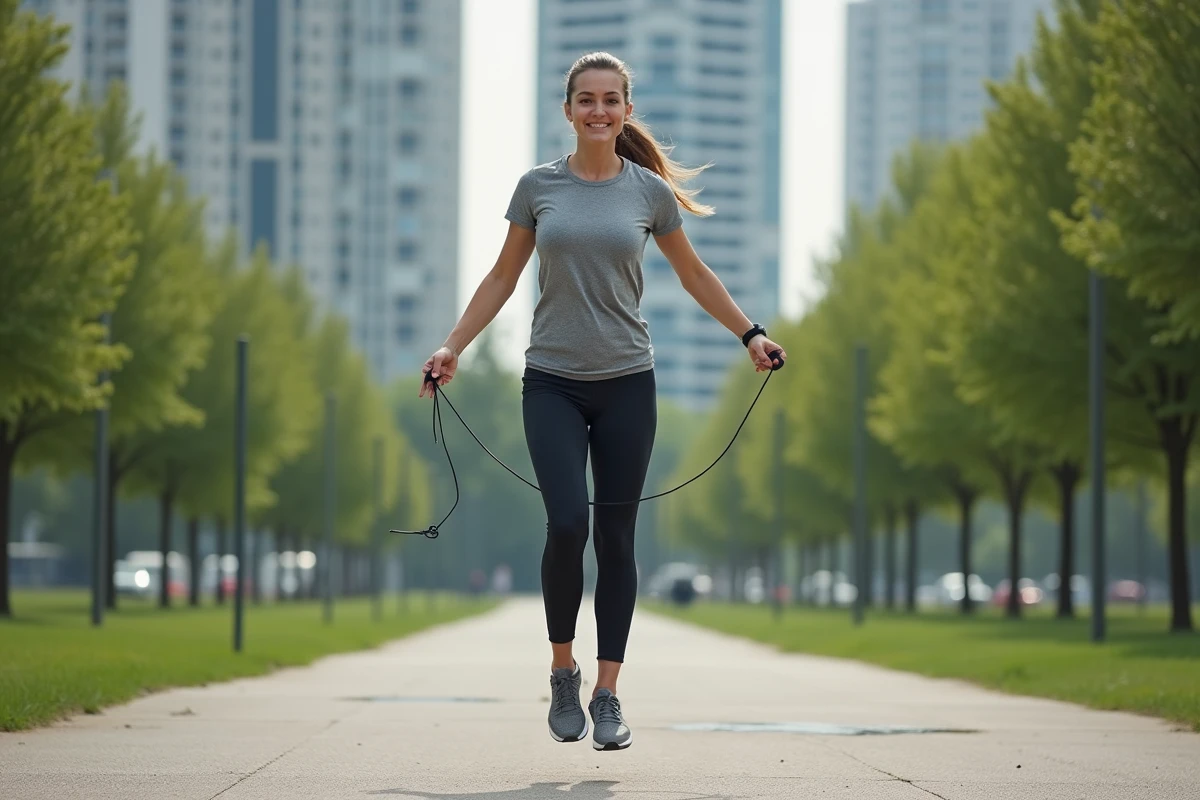
The figure of 1000 jumps with a jump rope per session often appears in sports recommendations, but its real impact on the body remains unknown. Contrary to some beliefs, this volume of exercise is not only aimed at seasoned athletes and does not necessarily involve increased risks for the joints.
Behind this practice, several specific benefits emerge, validated by recent studies. The effects concern both energy expenditure, cardiovascular improvement, motor coordination, and muscular endurance. Some barriers, such as the preconceived notion of an inaccessible difficulty, are gradually being challenged by the experiences of practitioners of all ages.
1000 jumps with a jump rope: a challenge for everyone, far from clichés
No need to don the costume of a high-level athlete to consider 1000 jumps with a jump rope. This goal has left the elitist sphere to infiltrate the training of people from all walks of life. On social media, the consensus is unanimous: the accessory is modest, but the transformations are very real. The rope represents a return to a form of raw, universal exercise that tests coordination, sharpens breath, and tones muscles in record time.
In ten minutes, one can be surprised to accumulate several hundred jumps, to feel the power in the legs, the discreet yet crucial involvement of the abs, and the necessity to optimize movement from the wrists. Here, everything is learned gradually. Turning the rope is effective only if one adopts the right technique, the one that preserves energy and saves the joints. The skills gained? They go beyond cardio: balance, reactivity, spatial awareness, all valuable assets that are little worked on elsewhere. The ideal rope must be chosen, adjusted to one’s height, with comfortable handles, to make the experience safe and motivating.
One point often noted by new practitioners is the rope’s ability to adapt to everyone: rhythm, duration, intensity, everything is adjustable. Progress comes quickly because one can go at their own pace and dose the effort, session after session. The result? The risk of injury is reduced while consolidating physical condition without harshness.
What effects can be expected on the heart, breathing, and physique?
Jumping rope is not just a child’s game revisited. On a cardiovascular level, the results are telling: the heart speeds up, blood circulates better, and one feels their breath transforming. A thousand turns of the rope equate to a physical expenditure close to that of running, but over a concentrated duration. Deeper breathing, optimized oxygenation: regularity quickly changes the game, even for those who are less athletic at the start.
In terms of energy expenditure, the exercise hits the mark. The numbers speak: depending on the adopted rhythm, up to 12 calories per minute can be burned. For an average-sized person, 1000 jumps represent about 100 calories, and the afterburn effect, the continued combustion after the session, further accentuates the phenomenon. Visually, the body becomes leaner, the legs gain strength, and the waist firms up without one noticing the passage of time.
To summarize the effects identified by studies and practical experience:
- Caloric expenditure: up to 12 calories each minute, depending on the effort
- Improved endurance: often noticeable within the first two weeks
- Body toning: legs, abs, and arms naturally sculpted through repetition
The versatility of the rope no longer needs to be proven: several muscle groups work in rhythm, cardio is engaged, and posture improves. And for those who wish to measure the progress made, some objective concepts are worth noting. The benefits of 1000 jumps with a jump rope are not theoretical: they are observed day after day, both in motivation and in the reshaping of the physique.

Which muscles are worked? Visible results and tips for starting easily at any age
The jump rope is not just a memory from the playground. Round after round, it engages several areas neglected by other exercises: the abdominal belt for balance, the calves for shock absorption, the thighs for propulsion, the forearms and shoulders for precise rotation. The movement is short, precise, but the repetition strengthens the arms, belly, and legs deeply. The whole body gains firmness, and posture improves quickly.
By testing the 1000 jumps, first in sets, then continuously for the more seasoned, one quickly notes progress: more defined legs, better stability, naturally straight back, increased mobility in the hips and ankles. Many observe an evolution within just the second week.
Starting a jump rope routine poses no insurmountable difficulty, regardless of age. To ensure everything goes smoothly, a few reflexes: select a rope suitable for one’s height, ensure to turn from the wrists rather than the arms, and prefer a soft surface to limit impacts. Alternating jumps (both feet together, on one foot, in motion) allows for varied stimulation and keeps the enjoyment intact.
For effective progression and to avoid minor pitfalls, some concrete tips are essential:
- Remember to specifically warm up the joints before starting
- Gradually increase the number of rounds, do not speed up the pace right away
- Check that the rope is adjusted exactly to your body type: a detail that changes everything
Ultimately, what matters most is consistency. With a bit of dedication, the movement becomes fluid, and progress is reflected in both sensations and physical condition. And the jump rope becomes, over the weeks, a companion for an active, intergenerational daily life, far from any rigid routine.
One thousand jumps is much more than a numerical performance: it is a springboard for energy, body awareness, and the pleasure of taking on a challenge, session after session.