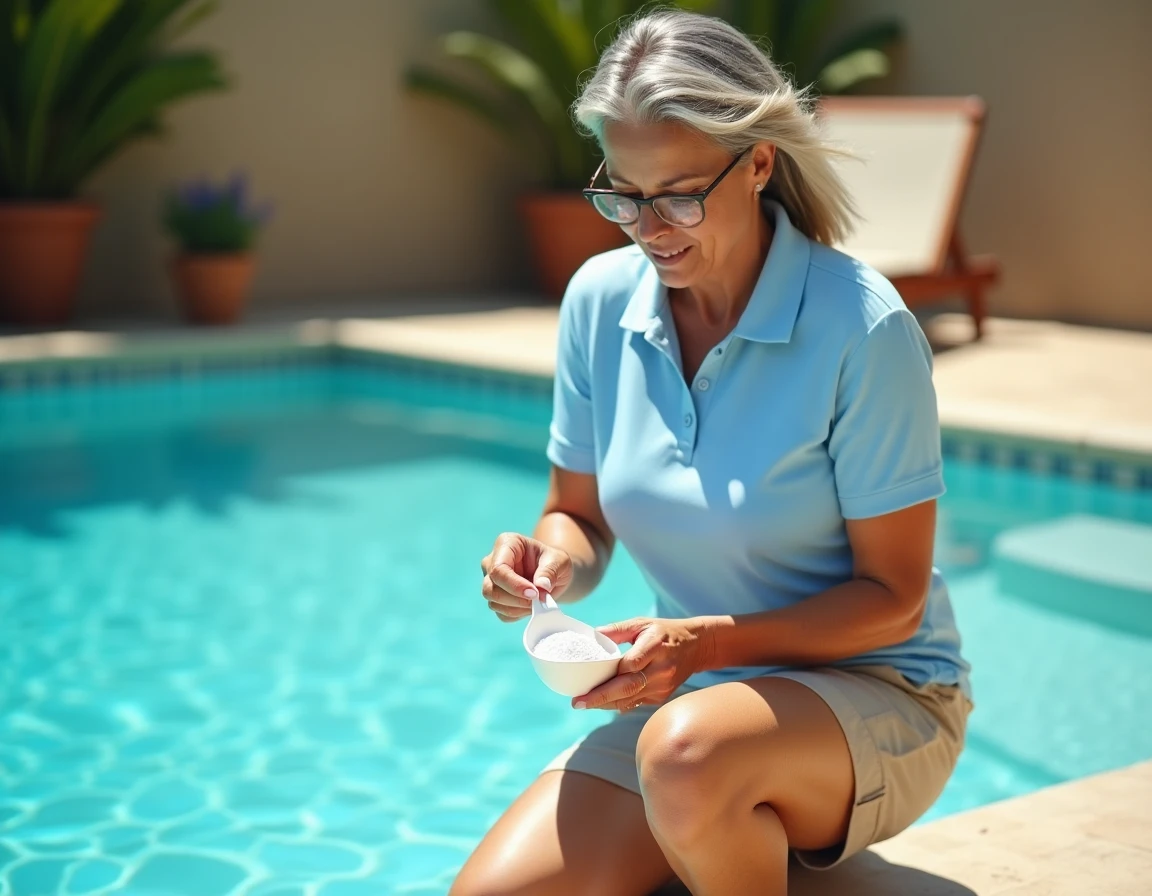
Chlorine destroys bacteria and microorganisms, while the clarifier aggregates particles that are too fine to be captured by the filter. These two products address distinct problems, and their effectiveness largely depends on the order and timing of their introduction into the pool.
Stabilizer and free chlorine: the parameter that most treatments ignore
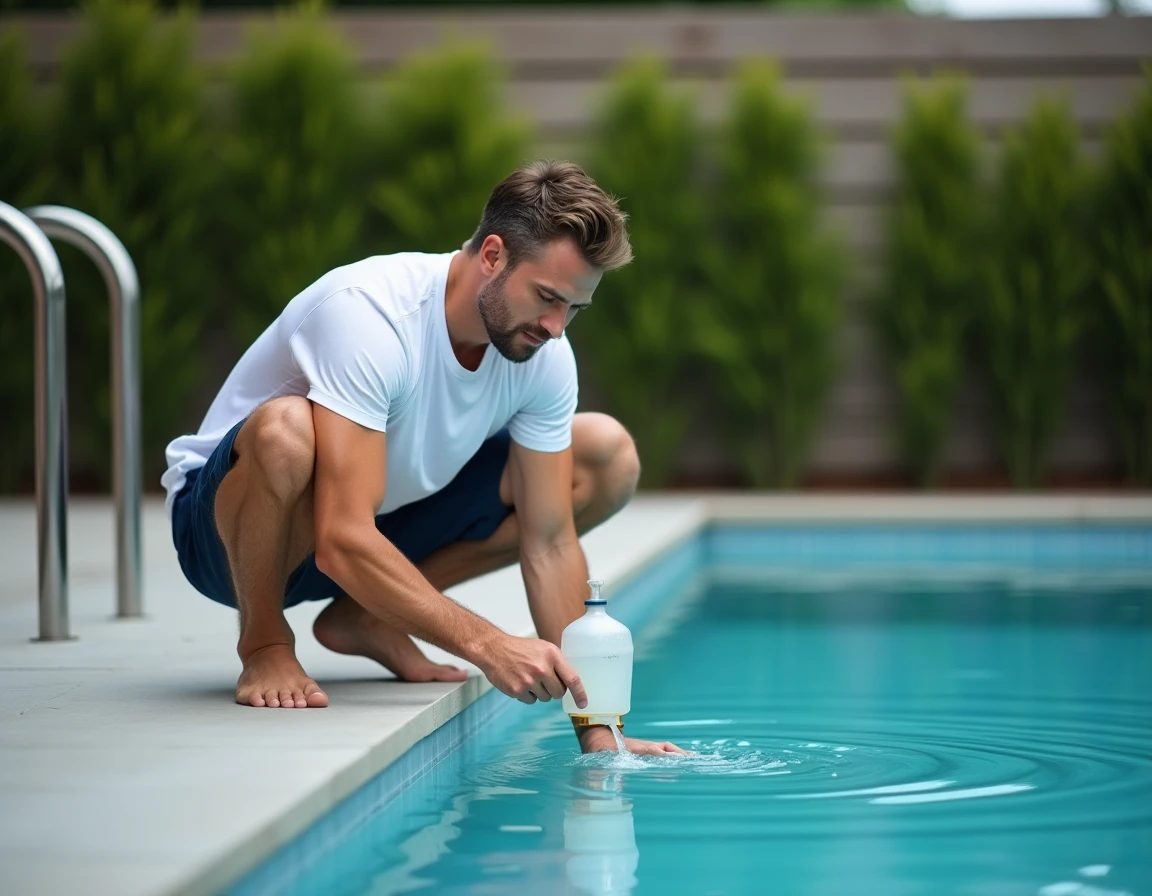
Before even discussing dosage or timing, one factor conditions the success of any chlorine treatment: the level of stabilizer (cyanuric acid) present in the pool. The stabilizer protects chlorine from degradation by UV rays, but beyond a certain threshold, it literally blocks its disinfecting power.
In practical terms, a pool overloaded with stabilizer will not respond to shock chlorine. Chlorine binds to cyanuric acid and remains inactive. Owners then add dose after dose with no visible results, and then blame the clarifier for not working.
The only solution to excess stabilizer is a partial dilution of the pool: draining part of the water and replacing it with fresh water. Knowing when to add chlorine and clarifier first requires checking that chlorine can actually act. Without this step, the rest of the protocol is compromised.
Test the stabilizer level with a test strip or colorimetric kit before each corrective treatment. If the level is too high, there’s no point in wasting shock chlorine: start by renewing the water.
Shock chlorine then clarifier: the sequencing that makes the difference
The common reflex is to pour chlorine and clarifier at the same time to save time. This approach reduces the effectiveness of both products.
Why shock chlorine goes first
The shock chlorine (non-stabilized) aims to destroy organic matter, budding algae, and chloramines responsible for the characteristic smell. As long as these pollutants are present, the clarifier has nothing useful to aggregate: the particles it gathers remain charged with organic matter and clog the filter without clarifying the water.
The protocol recommended by several recent technical sheets is as follows:
- Adjust the pH between 7.0 and 7.4, the range in which chlorine retains its maximum oxidizing power
- Perform shock chlorine at the end of the day (UV rays quickly degrade non-stabilized chlorine) and let the filtration run continuously
- Wait at least 24 hours of continuous filtration before introducing the clarifier, allowing time for the chlorine to complete its disinfection work
The clarifier acts on already disinfected water
Once the shock chlorine dissipates below the swimming threshold, the clarifier comes into play. Its role is to capture suspended micro-particles (dust, residues of dead algae, limestone particles) that the filter lets pass. It aggregates them into larger clumps, sufficiently large to be retained by the filter media.
The clarification time varies according to the water load and the type of filter, but filtration must remain active throughout the treatment duration. Stopping the pump means allowing the clumps to settle to the bottom without evacuating them.
Clarifier and flocculant pool: two mechanisms not to be confused
The clarifier and flocculant share a goal (to make the water clear) but work differently, and they are not compatible with the same filters.
The clarifier aggregates suspended particles so they can be captured by the filter. It works with all types of filtration: sand, cartridge, diatomaceous. The water passes through the normal circuit.
The flocculant, more powerful, creates dense clumps that fall to the bottom of the pool. These deposits must then be manually vacuumed to the drain. A flocculant should never be used with a cartridge filter, as the clumps irreversibly clog the cartridge.
For water that is simply cloudy after a storm or heavy use, the clarifier is sufficient. The flocculant is reserved for more critical situations: advanced green water, recovery after a failed winterization, or a pool left untreated for several weeks.
Spring pool restart: treat as soon as water reaches 12 °C
The seasonal calendar plays a crucial role. Waiting for the water to exceed 15 or 18 °C to restart treatment, as many owners do, gives algae time to colonize the pool. Maintenance specialists now recommend restarting treatment as soon as the water reaches 12 °C.
At this temperature, algae begin to develop slowly. Acting early allows for neutralization before they settle in, avoiding a costly recovery in shock chlorine and clarifier a few weeks later.
The spring restart sequence follows a precise logic:
- Mechanical cleaning of the pool (walls, bottom, skimmers, pump baskets)
- pH adjustment, then shock chlorine with continuous filtration
- Add the clarifier after the disinfection phase to eliminate remaining fine residues
- Check the stabilizer level before switching back to regular stabilized chlorine treatment
This early protocol significantly reduces the total amount of products needed throughout the season. Water treated early remains easier to maintain than water recovered in an emergency.
Filtration and operating duration: the often underestimated factor
No chemical treatment replaces sufficient filtration. The empirical rule remains to divide the water temperature by two to obtain the number of hours of daily filtration. At 26 °C, the pump should run for at least 13 hours.
After shock chlorine or the addition of a clarifier, filtration must run continuously, without nighttime interruption. Stopping the pump at night while the clarifier is active allows the aggregated particles to settle again. The next morning, the water appears as cloudy as before the treatment.
Also consider cleaning the filter. A clogged filter reduces flow and prevents the clarifier from doing its job. A backwash (for sand filters) or rinsing of the cartridge before each corrective treatment significantly improves the final result.
Chemistry corrects, filtration maintains. Adding chlorine and clarifier to a pool with a saturated filter is like treating the symptom without addressing the cause. A clean filter, adjusted pH, and controlled stabilizer: these three parameters combined are the foundation of water that remains clear without repeated interventions.