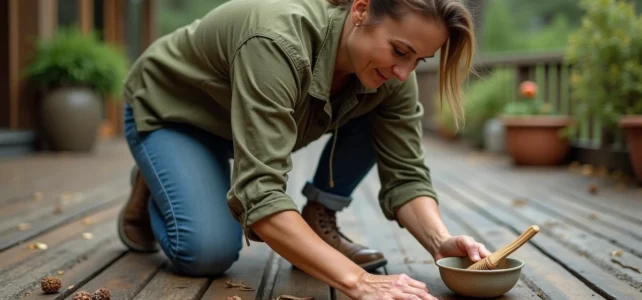
Pin resin on a softwood terrace (Scots pine, maritime pine, Douglas fir) is not a manufacturing anomaly. It is a natural exudate related to the resin canals in the wood, activated by heat and direct sunlight exposure. Autoclaved pine boards are particularly affected, as the autoclave treatment does not neutralize the resin trapped in the knots and internal pockets of the wood.
Mechanical scraping of resin: plastic spatula and thermal preparation
The first intervention on a fresh or sun-softened resin flow involves mechanical scraping with a plastic spatula. We systematically recommend a nylon or polypropylene spatula, never metal, to avoid scratching the wood fiber and exposing the untreated heartwood.
Before scraping, gently heating the hardened resin with a heat gun set to low temperature (minimum setting) softens the mass without burning the surface of the board. A hairdryer may suffice for small drips. The resin becomes pliable again in a few seconds and can then be removed in a single pass with the spatula.
To remove pine resin from a wooden terrace without altering the color, we combine this mechanical step with immediate cleaning using hot soapy water. Liquid black soap, diluted in hot water, dissolves the sticky residues that the spatula did not remove. Wipe with a microfiber cloth or a soft-bristled brush in the direction of the grain.
Vegetable oil versus solvents: which product to choose for pine resin
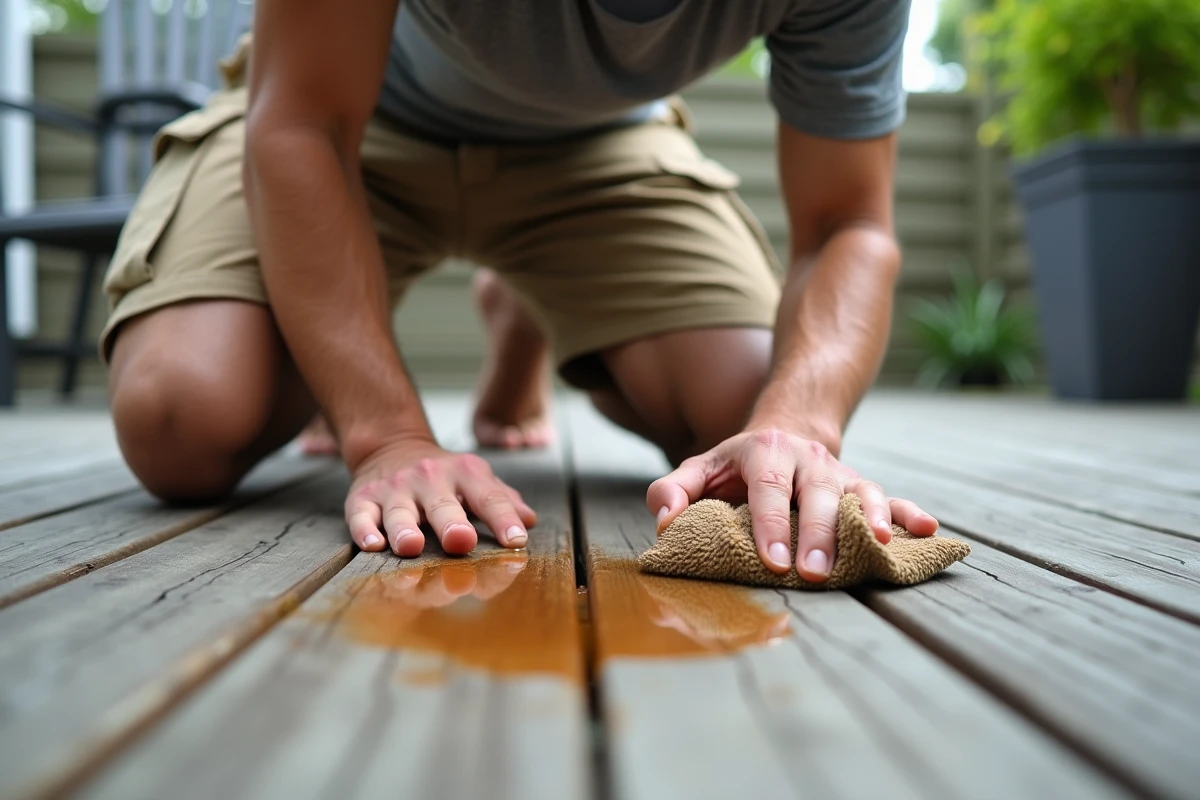
Vegetable oils are gradually replacing strong solvents in cleaning protocols for resinous terraces. Rapeseed or sunflower oil, applied directly to the resin stain, penetrates the sticky mass and detaches it through lipophilic dissolution. Let it sit for a few minutes, then wipe with a clean cloth before washing with soapy water.
Acetone and white spirit remain effective on resins that have hardened for several weeks. Their repeated use presents two concrete problems on treated wooden terraces:
- Localized discoloration of the board, with the appearance of a whitish area that does not naturally re-homogenize
- Alteration of the protective layer (saturator, oil, stain), which may void the manufacturer’s warranty on certain ranges of boards
- Toxicity in a family outdoor environment, especially if children or pets frequent the terrace barefoot
We therefore reserve solvents for localized touch-ups, on a discreet test area, and only when vegetable oil and soap have not sufficed. A preliminary test on a hidden corner of the terrace is the only way to verify the product’s compatibility with the existing finish.
90° alcohol and baking soda as a supplement
Household alcohol (or 90° alcohol) serves as an interesting intermediary between gentle oil and aggressive solvent. Applied with a cloth to the resin stain, it dissolves the sap without attacking most common finishes. Baking soda, mixed with a little water to form a paste, acts as a mild abrasive on ingrained residues. Rub the paste with a cloth, then rinse with clear water.
Never combine baking soda and white vinegar on wood: the acid-base reaction neutralizes both products and produces only ineffective foam, while risking staining certain wood species.
Post-cleaning maintenance: brightener and saturator to prevent recurrence
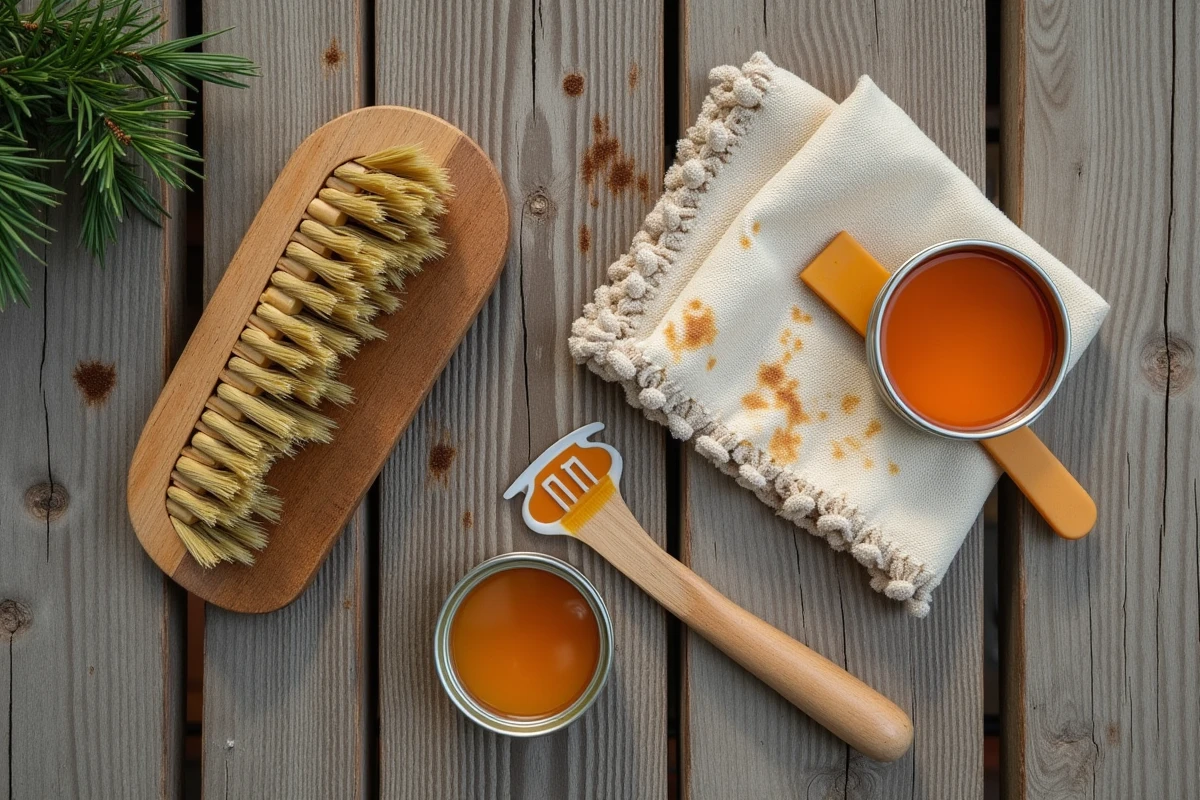
Removing resin is only half the job. The cleaned area often appears lighter or duller than the rest of the terrace. Without surface treatment after cleaning, the exposed wood grays faster, and residual resin in the deeper layers may rise during the next heat episode.
The sequence we systematically apply after resin cleaning:
- Application of a brightener on the treated area (or on the entire terrace if the color difference is visible), followed by thorough rinsing with clear water
- Complete drying of the board, ideally over a full day without rain
- Application of a wood saturator or a protective oil suitable for the type of terrace, following the number of coats indicated by the manufacturer
This brightener then saturator sequence is part of the annual maintenance routines recommended by board manufacturers and installation professionals. It limits the reappearance of resin on the surface and homogenizes the visual appearance across the entire decking.
Resin in wood knots: a special case on pine terraces
Knots are the areas of maximum resin concentration in a pine board. On some low-quality or poorly sorted boards, through knots contain pockets of resin that can ooze for several seasons. Scraping and cleaning only temporarily resolve the issue.
In this case, after completely cleaning the pocket, we apply a shellac in a dabbing technique on the knot to seal the area and block future seepage. This technique, borrowed from cabinetry, works well outdoors as long as it is later covered with the same saturator as the rest of the terrace.
If the resin returns despite two or three treatments, the affected board is likely a sorting reject that should have been discarded. Replacing this single board costs less in time and product than treating it every summer.
The initial choice of pine terrace boards with careful sorting (few knots, no black knots) remains the best prevention against recurring resin problems. On an already installed terrace, identifying the two or three most affected boards and concentrating maintenance on those avoids unnecessarily treating the entire decking.