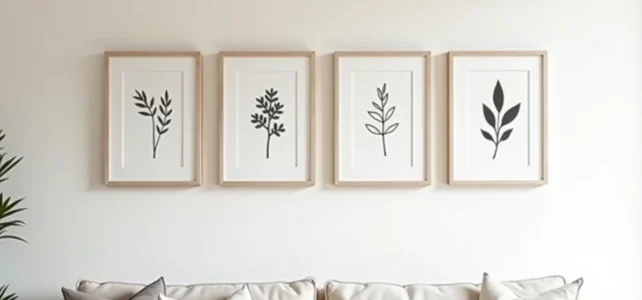
Five identical frames leaning against the wall, still wrapped, and already a question: where to start so that the result looks natural and not just “tidy”? Arranging identical frames on a wall seems simple in theory, but the uniformity of the format often traps you into a flat alignment that adds nothing to the room.
Everything hinges on three concrete parameters: the height of the center of the composition, the spacing between each frame, and the overall shape that the whole creates on the wall.
Visual horizon line: the reference that most guides overlook
Have you ever noticed that a frame hung too high forces you to look up, creating a sense of dislocation? This phenomenon amplifies with five frames: if the entire group is off by a few centimeters, the discomfort multiplies.
Recent decorating guides recommend placing the center of the composition between 1.45 m and 1.60 m from the floor. This reference corresponds to the average eye level in a contemporary interior. The idea is not to center each frame individually, but to consider the five frames as a single block whose midpoint falls within this range.
In practice, measure the total height of your composition (frames + spaces between them). Divide this number by two, then subtract the result from 1.52 m (a good compromise). You get the height at which to place the bottom edge of the lowest frame. An article detailing how to arrange 5 frames on a wall expands on this calculation with additional diagrams.
This method works whether you are standing in a hallway or sitting in a living room. In a living room with a sofa, some decorators lower the center slightly to around 1.40 m so that the composition remains comfortable from a seated position.

Spacing between identical frames: why two fingers are not always enough
The classic advice (“leave the thickness of two fingers between each frame”) works for small formats. With medium or large frames, this spacing seems cramped and gives the impression that the images visually overlap.
The spacing directly depends on the size of the frame. For small frames (about 20 x 30 cm), a space of three to five centimeters is suitable. For larger frames, increase to seven or eight centimeters. The goal: each image “breathes” without the group losing its cohesion.
A simple test before drilling: cut out five rectangles of paper to the exact dimensions of your frames, and attach them to the wall with repositionable tape. Step back two to three meters. If the rectangles seem to form a readable ensemble, the spacing is good. If not, adjust before touching the wall.
Regular or variable spacing
With five identical frames, strictly identical spacing reinforces the series effect, which is suitable for a hallway or a sober wall. If you are looking for more dynamism, keep the same horizontal space but slightly offset one or two frames in height. The group remains cohesive, but the eye moves differently.
Three concrete arrangements for five identical frames
Rather than listing ten variations, let’s focus on three layouts that actually work in standard homes.
- The horizontal line: the five frames aligned on the same axis, with regular spacing. The most sober arrangement, ideal above a sideboard or sofa. It works as long as the wall is at least one and a half times wider than the total composition; otherwise, the wall appears saturated.
- The two-three stagger: two frames on top, three on the bottom (or vice versa). The offset creates a visual triangle. Be sure to align the outer edges of the top frames with those of the bottom to maintain readable geometry.
- The cross (or more): one central frame, one above, one below, one to the left, one to the right. This layout draws the eye to the center and is particularly suitable for an isolated wall section, without furniture below.
Adapting the arrangement to the furniture
A sofa or low furniture beneath the composition visually anchors the group. The basic rule: the composition should not exceed two-thirds of the width of the furniture. Beyond that, the whole seems to overflow, and the furniture loses its role as a visual base.
On an empty wall (hallway, staircase), the composition can occupy more space, but keep visible side margins to avoid the “wallpaper” effect.
Matte paints and drywall: two current constraints to anticipate
Two elements rarely addressed in classic guides deserve attention when hanging five frames in the same spot.
Matte paints and velvet finishes
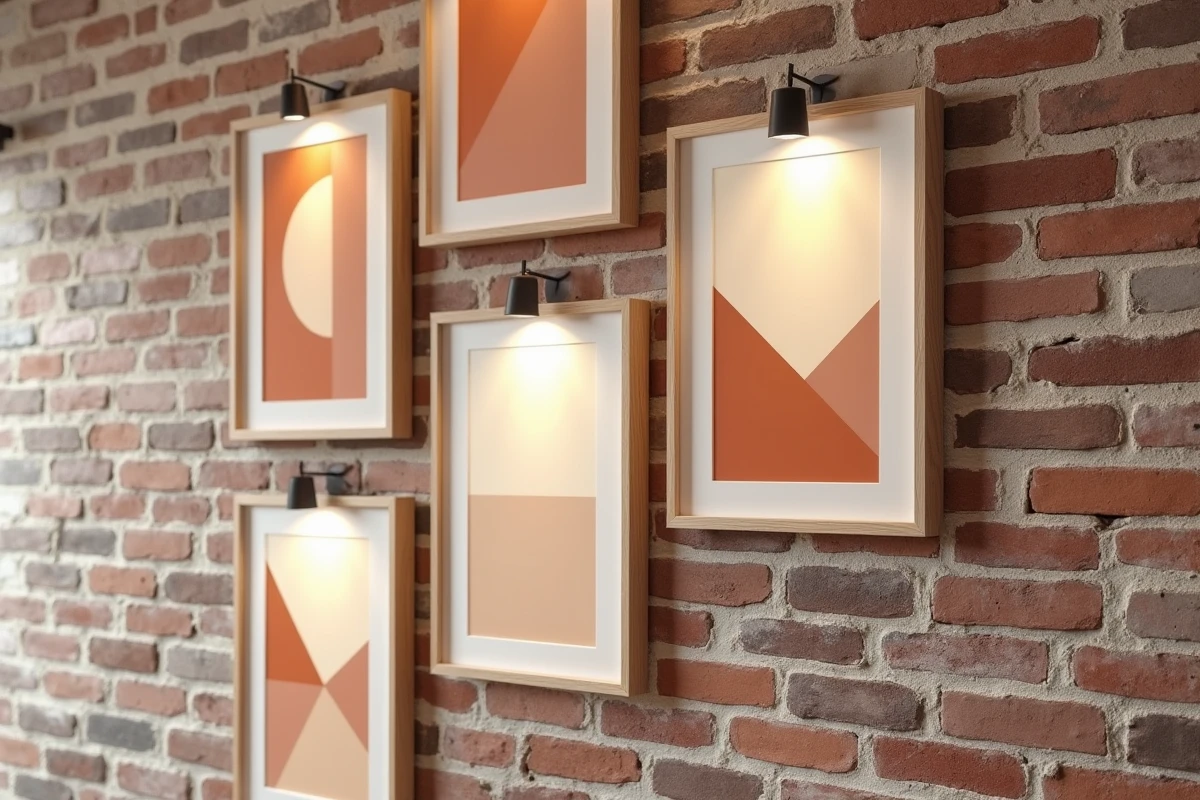
Matte or velvet finishes, very common in recent interiors, greatly reduce reflections on the glass of the frames. As a result, you can install your composition closer to a window or wall sconce without the light interfering with the readability of the images. With satin or glossy paint, reflections often force you to move the frames away from light sources, which reduces placement options.
Drywall and enhanced insulation
In recent homes, walls are often double-layered (drywall on insulation). Hanging five frames in the same spot, even if light individually, concentrates the stresses on a small area of the surface. Suitable anchors (like Molly or self-tapping anchors) are recommended as soon as the cumulative weight becomes significant. Before drilling, check the thickness of the board with a stud finder.
Last practical point: if your frames are light, repositionable adhesive strips offer a no-drill alternative. They also allow you to test the arrangement in real conditions for a few days before fixing it permanently. The best composition is the one you adjust after experiencing it, not just imagining it on a sketch.